|
The
Birman has also been called "The Sacred Cat of Burma", much of their
history is shrouded in mystery. The Birman was recognized as a
separate breed in 1925 by the French Cat Registry. By the end of
WWII, only two Birmans were left alive in Europe, and a
 program
of breeding and out-crossing was necessary to re-establish the
breed. England recognized Birmans, for championship, in 1966. They
were recognized by the Cat Fanciers' Association in 1967. program
of breeding and out-crossing was necessary to re-establish the
breed. England recognized Birmans, for championship, in 1966. They
were recognized by the Cat Fanciers' Association in 1967.
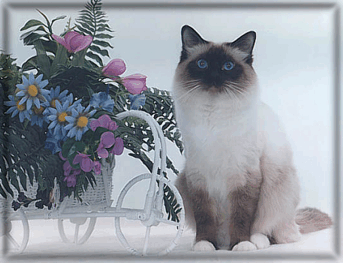
The ideal Birman is a large, long stocky cat. It has long silky hair
of a texture that does not mat. The Birman is a color pointed cat,
the color of the body is light, preferably with a golden cast, as if
misted with gold. The "points" - face, ears, legs, and tail - are
darker. The four traditional colors are seal point, blue point,
chocolate point, and lilac point. May 1, 2001 marked the acceptance
by CFA of the “new color” Birmans, which includes the lynx patterns
and red spectrum cats, bringing the total different color varieties
to 20. Birmans have almost round blue eyes, set in a strong face
with heavy jaws, full chin, and a Roman nose. They have very
distinctive white feet, called "gloves" and the white on the back
feet end in a point up the back of the leg, called "laces." It is
very difficult to breed a cat with four perfect white
gloves. .
The Birman's nature is kind and gentle, yet active and playful. They
are loving and sensitive cats, and enjoy living closely with humans.
|